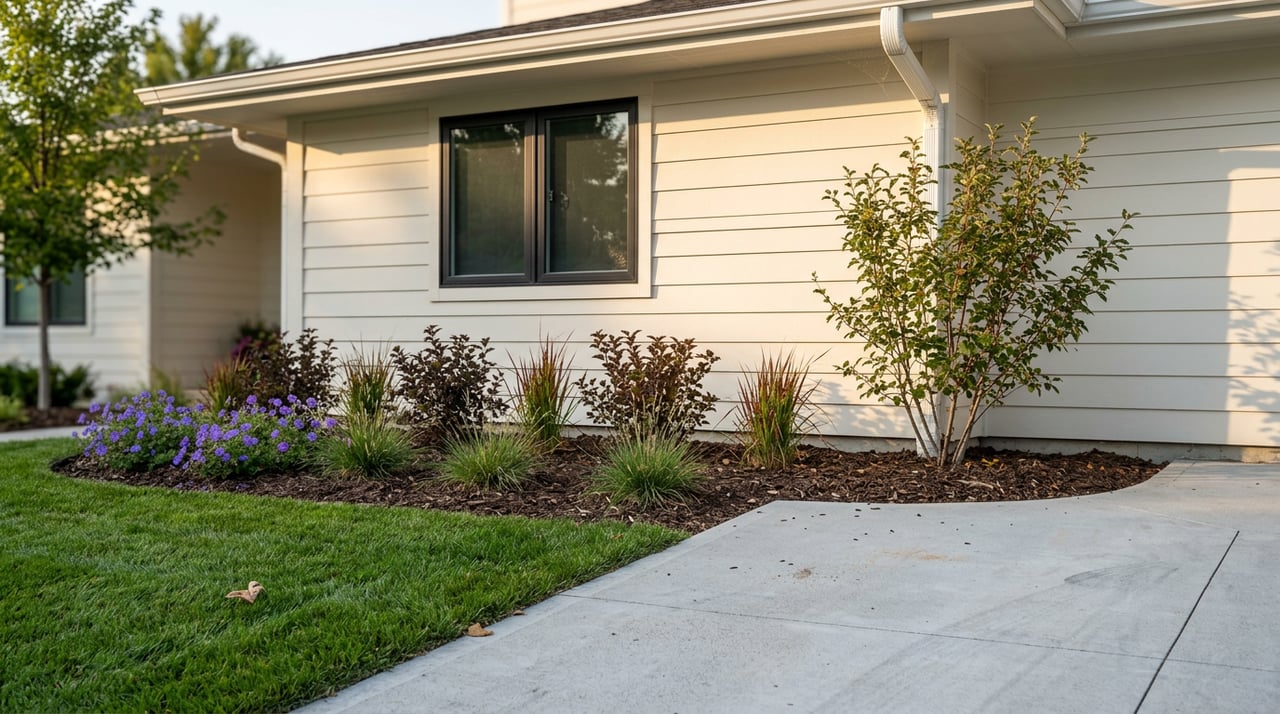
Two three-bedroom homes in Tea list within a few thousand dollars of each other. Same square footage, same finish level, same school boundary. A buyer comparing them on price per square foot would call it a coin flip. But if one sits in a subdivision still paying off the streets and sewer main that built it, and the other sits in an older section of town where those costs were retired years ago, the monthly carrying cost on paper-identical homes can diverge for the next decade or longer. That gap does not show up on the listing sheet. It shows up on a single line of the closing statement that most buyers have never heard of until someone hands them a form: the special assessment proration.
South Dakota's standard closing statement carries a line for county tax proration, a line for city tax proration, and a separate line for special assessment proration. Ordinary property taxes fund the general operations of the city, county, and school district and apply at roughly the same rate across a taxing jurisdiction. Special assessments are different. They are attached to a specific parcel because that parcel benefited from a specific piece of infrastructure, and they get billed alongside property taxes until the balance is paid off. In a city that has been building as fast as Tea, that distinction matters more than it used to.
Why this question is showing up on more Tea closings than it used to
The City of Tea's own 2025 Development Summary puts a number on the pace: the city added roughly 500 new residences and 60 living units in 2025 alone, representing more than $34 million in building permit value. Population sat at 8,051 as of January 1, 2026, in a city that was a fraction of that size not long ago. Growth at that speed does not get paid for out of thin air. Someone has to fund the streets, water mains, and sewer trunk lines that make a new subdivision buildable, and in South Dakota municipalities, that someone is usually the developer up front and the eventual homeowners over time.
Ownwell's analysis of Lincoln County property tax data puts a number on the result. As of the 2026 tax year, Tea's median effective property tax rate runs 1.55 percent, well above the 1.02 percent national median. Ownwell attributes part of that gap directly to the fact that the city's rate reflects the Lincoln County base levy combined with local school district levies and special assessment districts that vary by subdivision throughout the city. That last phrase is the whole story. The citywide median tells you almost nothing about what a specific address will actually cost to hold, because the assessment layer is not citywide. It is parcel by parcel.
How a subdivision ends up carrying its own bill
South Dakota law gives municipalities a specific tool for this. Under the framework described in the South Dakota Municipal League's guide to special assessments, a city can fund a local improvement, meaning the construction of a street, water main, or sewer line, and then assess the cost against the properties that specially benefit from it. The law allows that assessment to be divided into as many as forty annual installments, billed alongside the regular property tax bill until it is retired.
A real example of how this plays out in Tea sits in the city's own files. The Developer Assurance Agreement for the Serenity Addition, on record with the City of Tea, lays out exactly this kind of arrangement. The agreement describes the city extending a 12-inch trunk sanitary sewer line along East Brian Street to serve the subdivision, and it names North Katie Avenue as a collector roadway that the developer had to build to a higher standard than a typical residential street, with the city and developer splitting the cost of the oversized components. The document even leaves the door open for a roundabout at the Brian Street and Katie Avenue intersection, with the city engineer developing cost estimates if that option gets chosen. None of this is unusual for a fast-growing city. It is simply the mechanism, spelled out in public record, by which a specific patch of new construction ends up carrying costs that an established neighborhood across town never took on.
Ordinary tax versus special assessment, side by side
| Ordinary property tax | Special assessment | |
|---|---|---|
| Who it funds | City, county, and school district operations | A specific street, water, or sewer improvement |
| How it's set | Same rate applies across the taxing jurisdiction | Tied to the parcel that benefited, varies by subdivision |
| How long it runs | Ongoing, no fixed end date | Fixed term, up to 40 annual installments under state law |
| Where it shows up at closing | County tax proration and city tax proration lines | Its own proration line, separate from ordinary tax |
| Whether it must be disclosed | Reflected in the property's tax history | Explicitly asked about on South Dakota's seller disclosure form |
What's actually driving the assessments right now
Tea's growth is not evenly spread across the city, and neither is the assessment activity. A large share of it is concentrated in a handful of corridors where the infrastructure work is happening in real time. Bakker Landing, a 270-acre development along the I-29 and 271st Street corridor, has been building out as a mixed commercial and residential connector between Tea and Sioux Falls, anchored by businesses including Orthopedic Institute and Casey's. Just up the interstate, a diverging diamond interchange broke ground in November 2025 at 85th Street and I-29, part of a broader plan for a future Veterans Parkway that would eventually link I-29 and I-90 around the metro. Interchange and parkway work of that scale tends to run in parallel with new subdivision buildout nearby, because the same infrastructure investment that improves regional access also opens land for new streets and utility extensions.
On the residential builder side, Nielson Construction has been developing several named communities inside city limits at once: Serenity, a 55-plus active adult neighborhood, Serenity Park townhomes, High Pointe Estates, and Pinnacle. Each of those represents its own developer agreement, its own utility extension, and potentially its own assessment district with its own remaining balance and payoff date. That is a meaningfully different situation from a development like Prairie Acres, an acreage community southwest of Tea built on one to three-plus acre lots with paved roads but without full city water and sewer service. Homes on private well and septic outside city utility districts are less likely to carry a municipal special assessment in the first place, because the infrastructure that triggers one was never extended to them. The variation is not random. It tracks exactly where the city has been building.
Three questions before you sign
If you are comparing homes in Tea, especially anything built in the last five years, three questions are worth asking before you write an offer or accept one.
- Ask the title company for the parcel's special assessment balance and remaining installment term, not just the current year's tax bill. A home two years into a fifteen-year assessment carries a very different future cost than one that finished paying it off last year, even if this year's total bill looks similar.
- Ask which developer agreement covers the subdivision, and whether the infrastructure it describes is fully built or still in progress. Public developer agreements filed with the City of Tea, like the one covering Serenity Addition, spell out what was promised, what the city funded, and what the assessment was meant to cover.
- Confirm the disclosure was in hand before any offer was signed. South Dakota's Seller's Property Condition Disclosure Statement explicitly asks whether the seller is aware of any special assessments on the property, and state law requires that disclosure be furnished before a buyer makes a written offer. If it arrives after the offer instead, the buyer has a short window, three days if delivered in person or six if mailed, to terminate based on what the disclosure reveals.
FAQ
Is a special assessment the same thing as an HOA fee? No. An HOA fee funds private amenities and maintenance controlled by a homeowners association. A special assessment is a public charge levied by the city to pay for infrastructure like streets, water mains, or sewer lines, and it is billed and collected alongside property taxes.
Do all new construction homes in Tea have a special assessment attached? Not necessarily. It depends on how the specific subdivision's infrastructure was financed under its developer agreement with the city. Some costs are paid up front by the developer and folded into the home price. Others are structured as an assessment that continues billing the homeowner directly for a set number of years.
Can a special assessment be paid off early instead of over the full installment term? Assessment structures and payoff options are set by the specific resolution adopted for that improvement district. Anyone considering an early payoff should confirm current balance and terms directly with the Lincoln County Treasurer or the City of Tea before assuming a payoff amount.
Where do I find out if a specific address has an active assessment? Start with the title company handling the transaction and the Lincoln County Treasurer's office. The parcel's tax record will show whether a special assessment is attached and what remains outstanding.
A home's price tag tells you what you are paying today. It does not tell you what you are committed to paying for the next fifteen years, and in a city adding infrastructure as fast as Tea is right now, that difference is worth confirming before you sign anything. Merchant Home Group works these closings every week and knows which subdivisions carry active assessments and which have already cleared theirs. Put us to work.